ROI in Real Numbers: How to Quantify Safety Training’s Impact on Insurance and Productivity

For OHS professionals, HR leaders, CEOs, and business owners in the United States and Canada, this gap is becoming harder to defend. Boards want numbers. Insurers want proof. Executives want to know whether safety training is reducing risk or simply consuming time and budget.
This article focuses on how to quantify the real return on investment of safety training using insurance data, injury trends, and productivity metrics. It draws on real claims' patterns, regulatory expectations, and case examples to show how training moves from a cost center to a business lever.
Why the ROI Question is Now Unavoidable
The cost of workplace injury has increased steadily over the past decade. Medical costs are rising faster than inflation. Skilled labor shortages make replacement workers harder to find. At the same time, regulators are escalating enforcement when employers fail to demonstrate effective prevention.
In the U.S., employer costs associated with workplace injuries are estimated in the billions annually when medical treatment, wage replacement, legal costs, and lost productivity are combined. In Canada, workers' compensation boards consistently report billions in benefit payouts each year, with indirect costs often estimated at two to four times the direct claim value.
Against that backdrop, executives are asking a reasonable question. If we invest in training, how do we know it is working?
The answer is not found in completion rates. It is found by linking training to outcomes that already matter financially.
Understanding the Insurance Connection
Insurance is often the clearest place to see the financial impact of safety performance.
In the United States, workers' compensation premiums are heavily influenced by claim history and the Experience Modification Rate, or EMR. An EMR above 1.0 increases premiums. An EMR below 1.0 reduces them. Serious injuries, even a small number, can push the EMR up for several years.
In Canada, while the mechanisms differ by province, the principle is the same. Poor injury performance leads to higher assessment rates, surcharges, and in some jurisdictions, loss of rebates. Many provinces use experience rating programs that directly link claims performance to employer costs.
Safety training influences these outcomes in two primary ways. First, it reduces the frequency and severity of injuries. Second, it improves early reporting and response, which can reduce claim duration and cost.
Insurers are increasingly explicit about this link. Many now ask detailed questions about training programs during underwriting, particularly in higher risk industries.
The Productivity Side of the Equation
Insurance is only part of the ROI story. Productivity losses often exceed direct injury costs.
When a worker is injured, productivity is affected long before a claim is filed. Work slows. Supervisors spend time investigating. Coworkers are distracted. Temporary replacements may lack experience.
Studies in manufacturing, logistics, and construction consistently show measurable productivity declines following serious incidents. Some organizations report output reductions of five to ten percent in the weeks following an injury.
Effective safety training reduces these disruptions by preventing incidents in the first place. It also improves task efficiency. Workers who understand hazards and procedures clearly tend to work more confidently and make fewer errors.
This is where ROI calculations often underestimate impact. Safety training is not only about avoiding loss. It supports consistent, predictable operations.
Moving from Assumptions to Data
To quantify ROI, organizations need to move beyond assumptions and connect existing data sources.
Most companies already collect the information needed. It is simply not linked.
Key data sources include:
- Workers' compensation claims and costs
• EMR or experience rating metrics
• Injury frequency and severity rates
• Near miss and hazard reporting trends
• Overtime and replacement labor costs
• Productivity or output metrics by department
The goal is not to prove that training caused every improvement. The goal is to show credible correlations over time.
For example, if targeted training is introduced in a department and injury rates decline while similar departments remain unchanged, that is meaningful. If claim severity drops after retraining supervisors on early reporting and modified duties, that is measurable value.
Case Examples That Put Numbers to Training
Consider a U.S. distribution company that experienced rising workers' compensation premiums driven by musculoskeletal injuries. Claims data showed that most injuries occurred during manual material handling tasks. Rather than deploying generic training, the company introduced task specific microtraining combined with supervisor coaching.
Over two years, the company saw a reduction in lost time claims and a gradual improvement in its EMR. Premium increases slowed, then reversed. When finance analyzed the data, the savings in insurance costs alone exceeded the training investment several times over.
In Canada, a mid-sized manufacturer faced surcharges under its provincial experience rating program after a series of hand injuries. The company implemented focused retraining tied directly to machine setup and supervision. Injury frequency dropped, but more importantly, claim duration shortened due to earlier reporting and better return to work coordination. The financial analysis showed a clear reduction in assessment costs and indirect productivity losses.
These outcomes were not accidental. They were the result of linking training design to known cost drivers.
What Regulators Expect When Incidents Occur
Regulatory scrutiny amplifies the ROI question.
When a serious incident occurs, regulators examine whether training was effective. In the U.S., the Occupational Safety and Health Administration routinely evaluates whether training addressed the specific hazard and whether supervisors enforced it. Ineffective training can lead to citations that carry significant financial penalties.
In Canada, due diligence assessments frequently hinge on training quality and reinforcement. Courts often consider whether training was relevant, timely, and supported by supervision. Fines, legal costs, and reputational damage quickly eclipse the cost of proactive training.
From an ROI perspective, avoiding a single enforcement action can justify years of training investment.
Linking Training to Leading Indicators
Lagging indicators like injury rates are important, but they move slowly. Leading indicators provide earlier signals of ROI.
Examples include increases in near miss reporting, improvements in hazard correction timelines, and supervisor intervention rates. These metrics show that training is influencing behavior before injuries occur.
Organizations that track these indicators often find that improvements precede reductions in claims. This strengthens the business case for continued investment.
The HR Lens on ROI
HR professionals play a crucial role in capturing the full value of safety training.
Injuries drive turnover. Employees who feel unsafe are more likely to leave. Recruitment and onboarding costs add up quickly.
Training that improves safety culture also improves retention, particularly among experienced workers. HR data on turnover, absenteeism, and engagement can often be linked to safety improvements over time.
In addition, HR involvement ensures that training aligns with accommodation and return to work programs, further reducing claim costs.
Productivity Metrics Executives Care About
To resonate with executives, ROI discussions must use familiar language.
Instead of talking only about injury rates, connect training to metrics such as:
- Reduced overtime due to fewer absences.
- Improved schedule reliability.
- Lower rework and error rates.
- Increased supervisor time on productive tasks rather than investigations.
When safety training is framed as supporting operational stability, executive engagement increases.
Common Pitfalls in ROI Analysis
One pitfall is expecting immediate results. Insurance and claims metrics lag. ROI should be evaluated over multiple years.
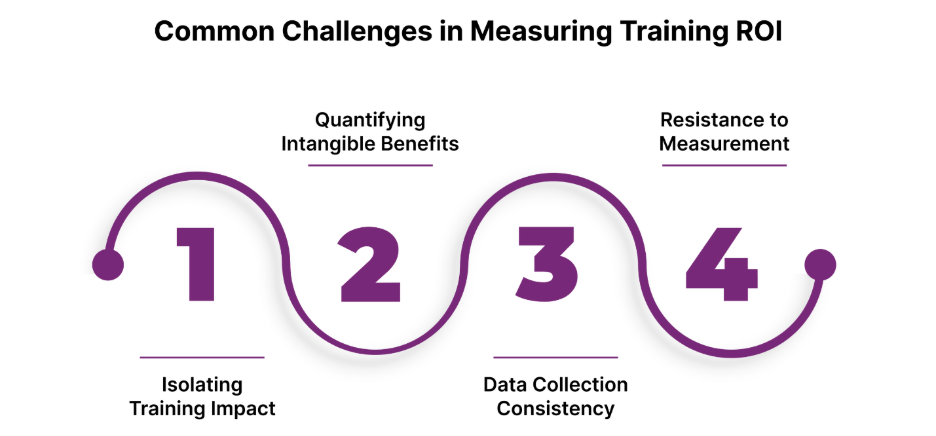
Another is isolating training from other controls. Safety improvements are often the result of combined efforts. Training does not operate in a vacuum.
Finally, avoid overcomplicating the analysis. Clear trends supported by credible data are more persuasive than complex formulas.
Regulatory Context in the U.S. and Canada
While regulatory systems differ, both environments reinforce the importance of effective training.
The table below summarizes how training outcomes intersect with regulatory and insurance expectations.
| Area | United States | Canada |
|---|---|---|
| Insurance linkage | EMR directly influences workers’ compensation premiums. | Experience rating programs link claims to assessment rates. |
| Regulatory focus | OSHA evaluates training effectiveness and supervision after incidents. | Regulators and courts assess training as part of due diligence. |
| Financial exposure | Penalties, increased premiums, and indirect costs. | Fines, surcharges, and lost rebates. |
| Documentation | Training records and evidence of behavior change. | Training records plus proof of worker understanding and application. |
Understanding this context helps organizations align ROI analysis with external expectations.
Building a Defensible ROI story
A defensible ROI story does not claim perfection. It shows intent, measurement, and improvement.
Organizations that can demonstrate that training investments are targeted, evaluated, and adjusted over time are better positioned with insurers, regulators, and internal stakeholders.
This also supports budget stability. When training is clearly linked to financial outcomes, it is less vulnerable during cost cutting cycles.
The CEO and Owner Perspective
For CEOs and business owners, safety training ROI is ultimately about risk management and resilience.
Training that reduces injuries stabilizes insurance costs. Training that improves productivity supports growth. Training that demonstrates due diligence protects the organization when something goes wrong.
Seen through this lens, safety training is not an expense to justify. It is an investment to manage strategically.
Closing Thoughts
Quantifying the ROI of safety training does not require complex models or perfect data. It requires discipline, alignment, and a willingness to look beyond completion rates.
By linking training to insurance performance, claims trends, and productivity metrics, organizations can tell a clear and credible story about value.
For OHS professionals, HR leaders, CEOs, and business owners across the U.S. and Canada, the message is straightforward. Safety training already affects your bottom line. Measuring it properly simply makes that impact visible.